How do I turn my garage into a home gym?
Start with the exercises you actually do, the available ceiling height and whether cars will still share the space. Build a dry, comfortable and safely powered training area before buying large equipment or installing mirrors.
Free on-site estimate — call (470) 999-6963
Updated · HG Garage Door
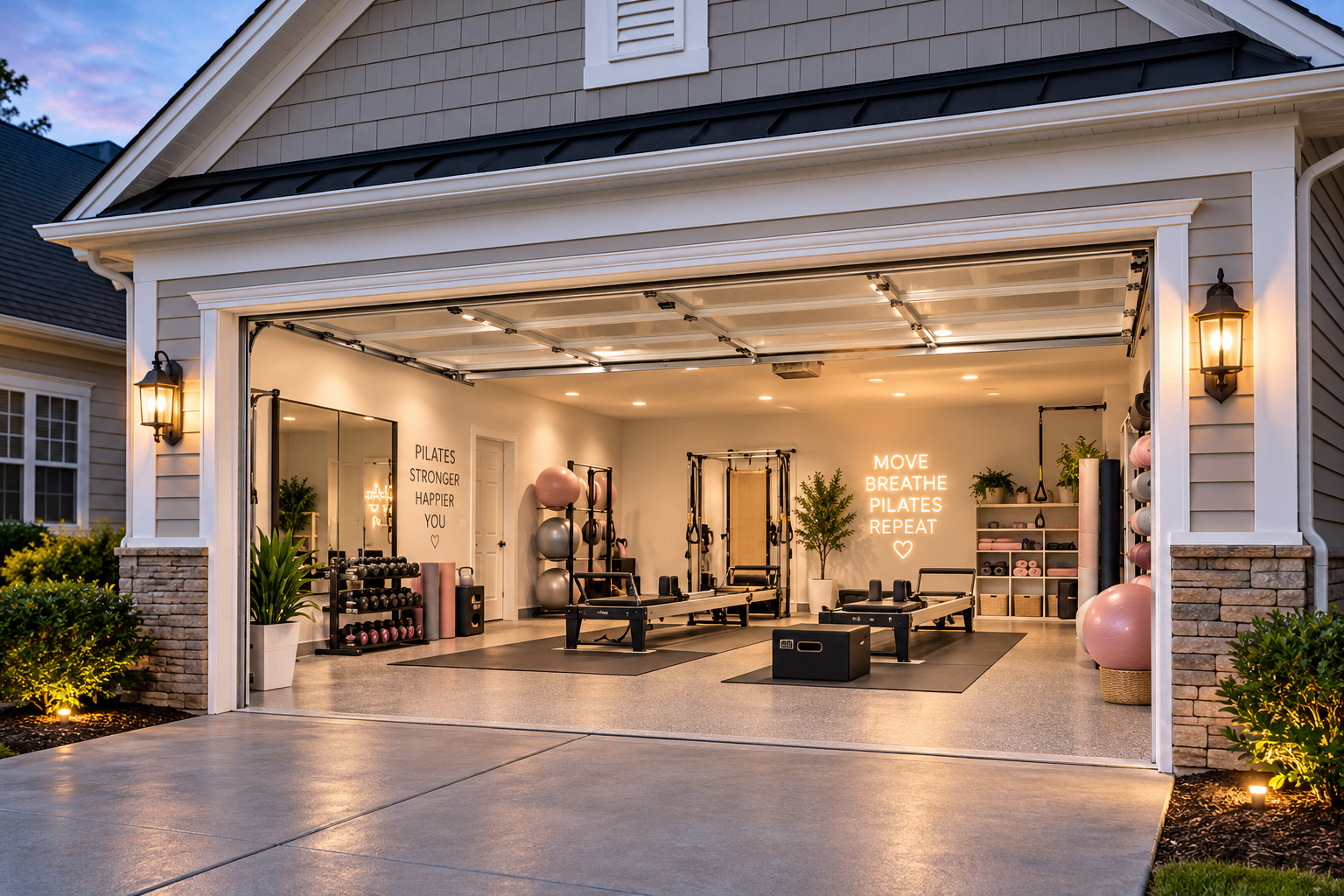
How much space does my equipment really need?
Measure the equipment in use, not just its folded footprint. A treadmill needs the clear area specified by its manufacturer, and a rack needs room for the bar, plates and a person moving around it.
Draw your garage with the door open and closed, including tracks, springs, the opener rail and utility access. Mark a safe walking route to the house and any required exits. Check overhead movement for presses, pull-ups and jump-rope work without standing under a moving door.
Do not assume a tall ceiling means the entire bay has usable height. If parking remains, tape the vehicle footprint and door swing onto the floor before choosing gym boundaries. Store weights where they cannot roll under a car or into the door track.
A smaller equipment list with a clear movement zone is often more usable than filling every wall with machines.
What floor works for weights and everyday exercise?
Choose the floor assembly for both the slab condition and the impact it will receive. A coating can provide a cleanable base, while purpose-designed rubber may protect an exercise zone from repeated contact.
Have cracks, uneven areas and moisture concerns evaluated before laying mats that hide the slab. Compare rubber thickness, odor information, cleaning requirements and compatibility with the underlying finish. Thin foam tiles are not a substitute for a platform or flooring rated for your equipment.
Keep mat edges secure so a loaded bar or fast foot movement does not catch them. If cars still park in the garage, verify that the selected products tolerate the expected traffic and remove oils before they reach a training area. Use the equipment manufacturer's guidance for mounting and loading, and discuss repeated impact on an older slab with a qualified professional rather than assuming epoxy alone makes it suitable.
How do I handle Georgia heat and humidity during workouts?
Reduce heat entry and air leakage before sizing a cooling solution. Insulation, a well-sealed door and properly assessed climate equipment work together; none should be promised to make every garage comfortable on its own.
A hot car, direct afternoon sun and air gaps all affect conditions differently. Consider where the door faces and whether the room above or beside the garage needs protected separation. Ventilation does not necessarily dehumidify hot outdoor air, and a fan mainly changes how moving air feels.
Ask a qualified HVAC professional about cooling capacity, condensate handling and electrical requirements for a mini-split if that is appropriate. Keep exhaust gases out of the gym: never idle a car or use a combustion generator in the enclosure. If parking and exercise share one bay, arrange a routine that separates those activities and allows the space to be safe before training begins.
Where should mirrors, lights and outlets go?
Put lighting and mirrors where they support the workout without obstructing the garage door or creating glare. Plan power before closing walls so exercise equipment does not depend on extension cords crossing the floor.
A licensed electrician should assess additional circuits and the actual requirements of powered equipment. Locate outlets away from likely impact and water exposure, with required protection confirmed for the setting. Use securely mounted lighting that remains outside the door's movement envelope.
Mirrors need suitable backing and installation; an oversized loose mirror leaning against a wall is not a safe gym feature. Check whether a rack or wall-mounted trainer needs structural blocking, and have its support assessed rather than drilling into unknown framing. Keep electrical panels and utilities accessible.
Leave switches reachable from the entry and avoid a lighting arrangement that leaves a person lifting weights in a shadow behind an open overhead door.
Does a garage gym need permits or a different room classification?
The answer depends on the scope and intended use, not on calling the room a gym. Electrical changes, HVAC installation, structural attachments or conversion to occupied space can create requirements beyond painting and movable equipment.
Confirm the authority serving your address before work starts. A postal city may not be the jurisdiction issuing the permit, especially around Marietta, Kennesaw and North Fulton boundaries. Explain whether parking will remain and whether the garage door and house separation will change.
Ask about the proposed insulation, heating, ventilation and floor plan together instead of seeking approval for isolated items. Check HOA rules for visible door replacements and exterior climate equipment separately. Confirm the approved room use with your building office before treating a garage gym as additional living area.
A reversible workout corner and a permanent conditioned room are different projects, with different documentation and potential inspection needs.
What is the sensible installation order and budget conversation?
Plan the layout, address repairs and approvals, complete concealed work, and finish surfaces before bringing in heavy equipment. This keeps exercise gear away from drywall dust and prevents dragging it across a floor that is still curing.
Ask the estimate to distinguish the garage makeover from fitness equipment purchases. The floor, door, insulation, electrical work and climate choices can change the scope substantially; no single price fits every home gym. Ask for a free on-site quote that separates the garage finishes from the fitness equipment you plan to buy.
Allow time for material selection, required inspections and the chosen coating's release stages. Move equipment in using the flooring and equipment makers' instructions, with help for heavy loads. At handover, save cleaning guidance and mounting details and check that all door movement and utility access still work.
Resist adding a final rack in a leftover corner if it removes the safe exit route you planned.
What else should I know before starting?
Can I keep parking in a garage home gym?
Often, if the room dimensions and equipment clearances allow it. Keep vehicle movement, exhaust exposure and exercise separate, and maintain a clear route to the house and utilities.
Is epoxy enough for dropping weights?
Do not assume so. The slab, coating and impact protection each matter. Select an exercise-rated surface or platform for the equipment and ask about repeated impact and finish compatibility.
Will an insulated door cool my garage gym?
It can reduce heat transfer through the door, but it is only one part of the enclosure. Air leaks, walls, ceiling, sun exposure and properly assessed climate equipment also matter.
Can HG quote the garage work before I buy a rack?
Yes. Bring the equipment dimensions and intended exercises to the free estimate so the layout, finish sequence and supporting trades can be planned first.
Plan your garage makeover
Tell us what you want your garage to do. Call or send the form below to arrange your free on-site estimate.
HG Garage Door · 1353 Riverstone Pkwy, Ste 120-259, Canton, GA 30114
Mon–Fri 9:00 AM – 7:00 PM · Sat Closed · Sun 10:00 AM – 3:00 PM